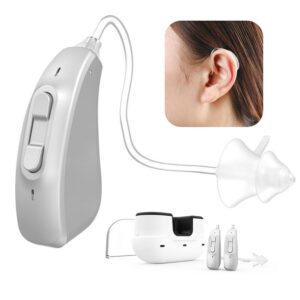
Telecoil (also called T-coil) is a small built-in feature found in some hearing Aids that allows users to receive sound directly from compatible audio systems instead of through the hearing aid’s microphone.
If you often struggle to hear clearly in public places such as theaters, hospitals, or places of worship, understanding how telecoil works can help you decide whether this feature is still worth choosing today.
This guide explains what telecoil is, how it works, where it is useful in real life, and how it compares with modern Bluetooth hearing aids.

What Is a Telecoil (T-coil) in hearing Aids?
A telecoil is a tiny copper coil installed inside a hearing aid.
Its job is not to pick up sound waves like a microphone.
Instead, it receives magnetic signals generated by compatible audio systems and converts them directly into sound inside the hearing aid.
When telecoil is activated, the hearing aid can receive audio without relying on the surrounding room acoustics.
This is why telecoil is especially helpful in noisy public environments.
How Does a Telecoil Work in a Hearing Aid?
Telecoil works using a simple electromagnetic principle.
When a sound system is connected to an induction loop (also called a hearing loop), the audio signal is sent through a loop of wire installed around a room or service area.
That loop creates a magnetic field.
The telecoil inside the hearing aid detects that magnetic field and converts it into an audio signal for the user.
Because the signal is transmitted directly, background noise, echo and distance from the speaker have far less impact on clarity.
What Is a Hearing Loop System and How Does It Work with Telecoil?
A hearing loop system is an assistive listening system installed in a room or at a service counter.
It typically consists of:
- an audio source (microphone or sound system), and
- a wire loop installed around the listening area.
When the user switches their hearing aid to telecoil mode, the hearing aid connects to the loop automatically.
Common locations where hearing loops are installed include:
- theaters and cinemas
- churches, mosques and other places of worship
- conference and meeting rooms
- hospital reception desks
- public service counters
In these locations, telecoil provides much clearer speech than normal microphone mode.
When Should You Use Telecoil in Real Life?
Telecoil is most valuable in environments where speech clarity is affected by distance, room acoustics or background noise.
Typical real-world situations include:
- listening to sermons or speeches in large halls
- watching performances in theaters
- attending meetings in conference rooms
- communicating at hospital or government service desks
Without telecoil, hearing aids rely on microphones and amplify both the speaker and the surrounding noise.
With telecoil, the sound comes directly from the audio system.
Many users report that voices become noticeably clearer and easier to follow when telecoil is available in these environments.
Telecoil vs Bluetooth in Hearing Aids
Both telecoil and Bluetooth allow hearing aids to receive audio directly, but they are designed for different use cases.
Telecoil
- works with public hearing loop systems
- requires no pairing or setup
- is very stable in loop-equipped venues
- is mainly used in shared public spaces
Bluetooth
- connects to personal devices such as phones, TVs and computers
- requires pairing and compatible devices
- is mainly designed for private, personal use
In practice, Bluetooth does not replace telecoil in public venues.
Most theaters and public buildings use hearing loops, not Bluetooth streaming systems.
Key Benefits of Telecoil in Hearing Aids
Telecoil offers several practical advantages for everyday users.
First, it significantly improves speech clarity in large or noisy environments.
Second, it reduces background noise because the sound is transmitted directly instead of through open microphones.
Third, it provides a simple and universal way to access public assistive listening systems without carrying extra receivers or headsets.
For many older users, telecoil is also easier to use than Bluetooth because no smartphone or pairing process is required.
Limitations of Telecoil You Should Know
Telecoil is not useful everywhere.
It only works when a hearing loop or compatible magnetic audio source is available.
If a venue does not have a loop system installed, telecoil mode will not provide any benefit.
In addition, not all hearing aids include telecoil.
Very small in-ear models may exclude it due to space limitations.
Telecoil also does not support private streaming from phones or TVs unless additional loop-based accessories are used.
Do All Hearing Aids Have Telecoil?
No.
Telecoil is more commonly found in:
- behind-the-ear (BTE) hearing aids
- receiver-in-canal (RIC) hearing aids
- some larger in-the-ear (ITE) models
Completely-in-canal (CIC) and very small custom devices often do not include telecoil because of size constraints.
Before purchasing, telecoil availability should always be confirmed in the product specification.
How to Know If Your Hearing Aid Supports Telecoil
You can check telecoil support in three simple ways.
Look at the technical specification of the hearing aid and search for:
- “telecoil”
- “T-coil”
- “T mode”
You can also ask your hearing care professional directly whether the model supports telecoil and whether it can be programmed for your listening needs.
How to Turn On and Use Telecoil Mode
Most hearing aids allow telecoil to be activated by:
- pressing a program button on the hearing aid, or
- using a mobile control app
You may see different listening programs such as:
- T mode – telecoil only
- M+T mode – microphone and telecoil combined
T mode is usually preferred in venues with good loop coverage.
M+T mode is useful when you still need to hear nearby sounds in addition to the loop signal.
Is Telecoil Still Relevant Today?
Even with the rapid growth of Bluetooth hearing aids, telecoil remains highly relevant.
Public buildings and accessibility programs around the world continue to deploy hearing loop systems because:
- one loop can serve many users at the same time
- users do not need personal receivers
- telecoil is supported by many existing hearing aids
From an accessibility and public-service perspective, telecoil remains one of the most practical and scalable assistive listening technologies.
Who Should Choose a Hearing Aid with Telecoil?
Telecoil is especially suitable for users who:
- frequently attend events in public venues
- participate in religious services or community meetings
- regularly visit hospitals and service centers
- value simple operation without relying on smartphones
If most of your listening challenges occur in large public spaces, telecoil can be more valuable than advanced streaming features.
Expert Tips Before Buying a Telecoil-Enabled Hearing Aid
Before selecting a hearing aid with telecoil, consider the following points.
First, check whether the public venues you regularly visit are equipped with hearing loop systems.
Second, confirm with your hearing care professional that telecoil can be properly activated and configured in your device.
Finally, remember that telecoil should be viewed as a complementary feature.
It works best when combined with modern noise reduction, directional microphones and proper professional fitting.
Choosing a telecoil-enabled hearing aid is not about replacing Bluetooth or smart features.
It is about ensuring reliable speech access in real public listening environments where clarity matters most.