When people search for “What is the 60-60 rule in audiology”, they are usually trying to protect their hearing—especially in a world full of headphones, smartphones, and streaming media.
But an important and often confusing question is:
Does the 60-60 rule apply to hearing aid users in the same way?
This article explains the 60-60 rule clearly and, more importantly, shows how it should be understood if you wear hearing Aids.

What Is the 60-60 Rule in Audiology?
The 60-60 rule is a simple public guideline designed to reduce the risk of noise-induced hearing damage.
It suggests:
- Listen at no more than 60% of the maximum volume
- For no longer than 60 minutes at a time
The rule is mainly promoted in hearing health education and personal listening safety campaigns, including global hearing-protection initiatives supported by the
:contentReference[oaicite:0]{index=0}.
The goal is not medical precision. It is an easy-to-remember habit for everyday users of headphones and earbuds.
Why the 60-60 Rule Exists
Prolonged exposure to loud sound can damage the sensory hair cells inside the inner ear. Once these cells are damaged, they do not regenerate.
Two main factors determine risk:
- Sound level
- Duration of exposure
Even moderate sound levels can become harmful if the exposure time is long enough. The 60-60 rule combines both factors into a simple behavioral guideline.
Was the 60-60 Rule Designed for hearing Aids?
No.
The 60-60 rule was created primarily for smartphones, music players, headphones and earbuds.
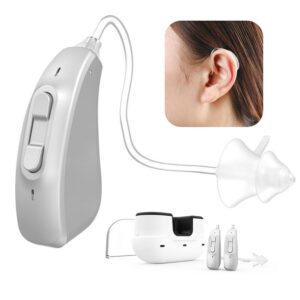
Hearing aids serve a very different clinical purpose. They are medical devices designed to compensate for hearing Loss, restore speech audibility and improve daily communication.
Because of this, applying the 60-60 rule directly to hearing aids is often misleading.
The Key Difference Between Headphones and Hearing Aids
Headphones
- Volume is controlled manually by the user.
- Output is not individualized.
- There is no professional calibration to your hearing threshold.
Hearing aids
- Gain is prescribed according to your audiogram.
- Maximum output is professionally limited.
- Amplification is frequency-specific and personalized.
In clinical fitting, hearing aids are programmed to deliver only the amount of sound needed to compensate for your hearing loss, not to boost sound for entertainment.
Why “60% Volume” Has No Meaning on a Hearing Aid
Many hearing aid users ask whether they should keep the volume below 60%.
In reality, hearing aids do not have a standardized “maximum volume” scale that corresponds to acoustic output in the same way consumer devices do.
The volume buttons adjust gain around a prescribed fitting target, within a limited and safe range.
60% on a phone and 60% on a hearing aid are not comparable measurements.
Is It Safe to Wear Hearing Aids All Day?
Yes—when properly fitted.
For most users, 8 to 14 hours of daily wear is normal and supports auditory adaptation and speech understanding.
Long wearing time alone does not cause hearing damage. What matters is whether the output and gain are correctly programmed.
Can Hearing Aid Users Still Be Exposed to Harmful Sound?
Yes—certain environments remain risky, such as factories, construction sites, live music venues and extremely loud public events.
Hearing aids amplify the surrounding environment. They do not automatically protect your ears from all high-level noise.
Can Turning Hearing Aids Up Too Much Be Harmful?
Modern hearing aids include output limits, compression systems and safety margins built into fitting software.
However, problems may occur when devices are poorly fitted or real-ear verification is skipped.
How Audiologists Control Safe Output
Professional practice guidelines and clinical standards are promoted by organizations such as the
:contentReference[oaicite:1]{index=1}.
Audiologists match amplification targets to hearing thresholds, verify output using real-ear measurements and set safe maximum levels across frequencies.
How Should Hearing Aid Users Interpret the 60-60 Rule?
The 60-60 rule should be viewed as a public listening habit guideline — not a hearing-aid fitting standard.
If you constantly need to increase volume to understand speech, the fitting usually needs adjustment rather than a time-based rule.
Practical Listening Safety Tips for Hearing Aid Users
Monitor listening comfort
Speech should be clear, not sharp or tiring.
Avoid using volume to fight noise
Use directional microphones and noise-reduction programs instead.
Use appropriate programs
Different programs for quiet, noise and music improve clarity without raising output.
Protect your ears in extreme noise
Hearing aids are not hearing protectors.
Schedule regular follow-ups
Small adjustments can significantly improve comfort and safety.
Common Questions
Should I limit hearing aid use to 60 minutes at a time?
No. There is no clinical reason to restrict wearing time like entertainment listening.
Do hearing aids protect my hearing from loud environments?
Not fully. They control amplification but do not replace hearing protection.
Is the 60-60 rule necessary if I wear hearing aids?
No. Personalized fitting and verification provide better safety control.
Final Takeaway
The 60-60 rule in audiology is a useful public reminder for safe recreational listening.
For hearing aid users, safety depends on individualized fitting, verified output levels, appropriate programs and professional follow-up.
Good audiological care replaces generic rules.