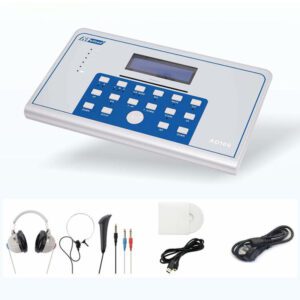
As the most common subjective hearing test method in clinical practice, pure tone audiometry (PTA) evaluates the hearing threshold of the subject at each frequency (i.e., the minimum sound pressure level at which the subject can recognize at least 50% of the sound signal).

The main method is the “Up-five-down-ten method”:
In order to familiarize the subject with the test task, first, a 1 KHz pure tone that can be clearly heard will be given to the subject (normal people generally take 40 dB).
After the subject responds, the test tone level is gradually reduced by 10 dB until there is no more response. Then the intensity is gradually increased (up) by 5 dB until there is a response. Repeat the test in this way until 3 out of 5 increases (which can be simplified to at least 2 out of 3 increases) occur at the same test sound level, then this sound level can be determined as the hearing threshold level of the frequency.
Test order:
Test the good ear first, then the bad ear.
The order of air conduction test frequencies is 1k, 2k, 4k, 8k, 500, 250 Hz (retest 1k Hz)
The order of bone conduction test frequencies is 500, 1k, 2k, 4k Hz
Note:
- If the difference of the retest of 1k Hz is ≥ 10, retest is required;
- If the difference of the octave is ≥ 20 dB, add half half-octave test.
Under what circumstances is it necessary to add a bone conduction test?
- Air conduction is abnormal (threshold > 20 dB).
- Air conduction is normal (threshold ≤ 20 dB), but the impedance chart is type B or type C.
Note:
- In general, air conduction is only abnormal at high frequencies of 4k and 8k Hz, which are mostly noise-induced hearing Loss and hair cell damage (sensorineural), and bone conduction does not need to be added.
- The air conduction transmission pathway is more complex than that of bone conduction, so the bone conduction hearing threshold must be lower (better) than that of air conduction.
Under what circumstances should masking be added? How much should it be added?
Air conduction masking
- Under what circumstances should masking be added?
When the difference between the air conduction threshold of the test ear and the bone conduction threshold of the non-test ear is greater than 40 dB, masking should be added to the air conduction of the non-test ear (good ear).
(The hearing of the non-test ear is completely normal, and the bone conduction can be considered equal to the air conduction)
- How much should it be added?
30 dB above the air conduction threshold of the non-test ear.
Threshold change (original value and value after initial masking) ≥ 20 dB, further masking + 20 dB is required.
Bone conduction masking
- Under what circumstances should masking be added?
When the difference between the air conduction and bone conduction of the ipsilateral ear is greater than 10 dB, masking should be added to the bone conduction of the non-test ear (slide back to see why).
- How much should it be added?
250 500 Hz adds 35 dB to the air conduction threshold of the non-test ear (initial masking level 20 dB + occlusion effect 15 dB).
1 kHz 30 dB above the non-test air conduction threshold.
2k 3k 4k Hz 20 dB above the air conduction threshold of the non-test ear.
Threshold change ≥ 15 dB, further masking +20 dB is required
Maximum masking level: interaural attenuation + test ear bone conduction threshold.
FAQ
- Why add masking?
When testing the deaf ear or the worse ear, the stimulus sound can vibrate the skull to the contralateral cochlea. If the contralateral cochlea functions well, cross hearing will occur. The measured hearing may be “eavesdropped” by the good ear on the other side. Therefore, to measure the true hearing of the worse ear, it is necessary to add masking noise to the contralateral ear (non-test ear).
- Whether to add masking to the non-test ear for bone conduction, and why to check whether the difference between air and bone conduction in the test ear is ≥10?
Because the interaural attenuation of bone conduction is 0, masking is theoretically required at any time, but in actual operation, to avoid meaningless increase in test time, in normal cases where the air and bone conduction are consistent or only differ by 5 dB, no additional masking is required; and when the difference between air and bone conduction is ≥10 dB, conductive hearing loss may occur, masking is required to confirm whether it is cross hearing or conductive hearing loss.